
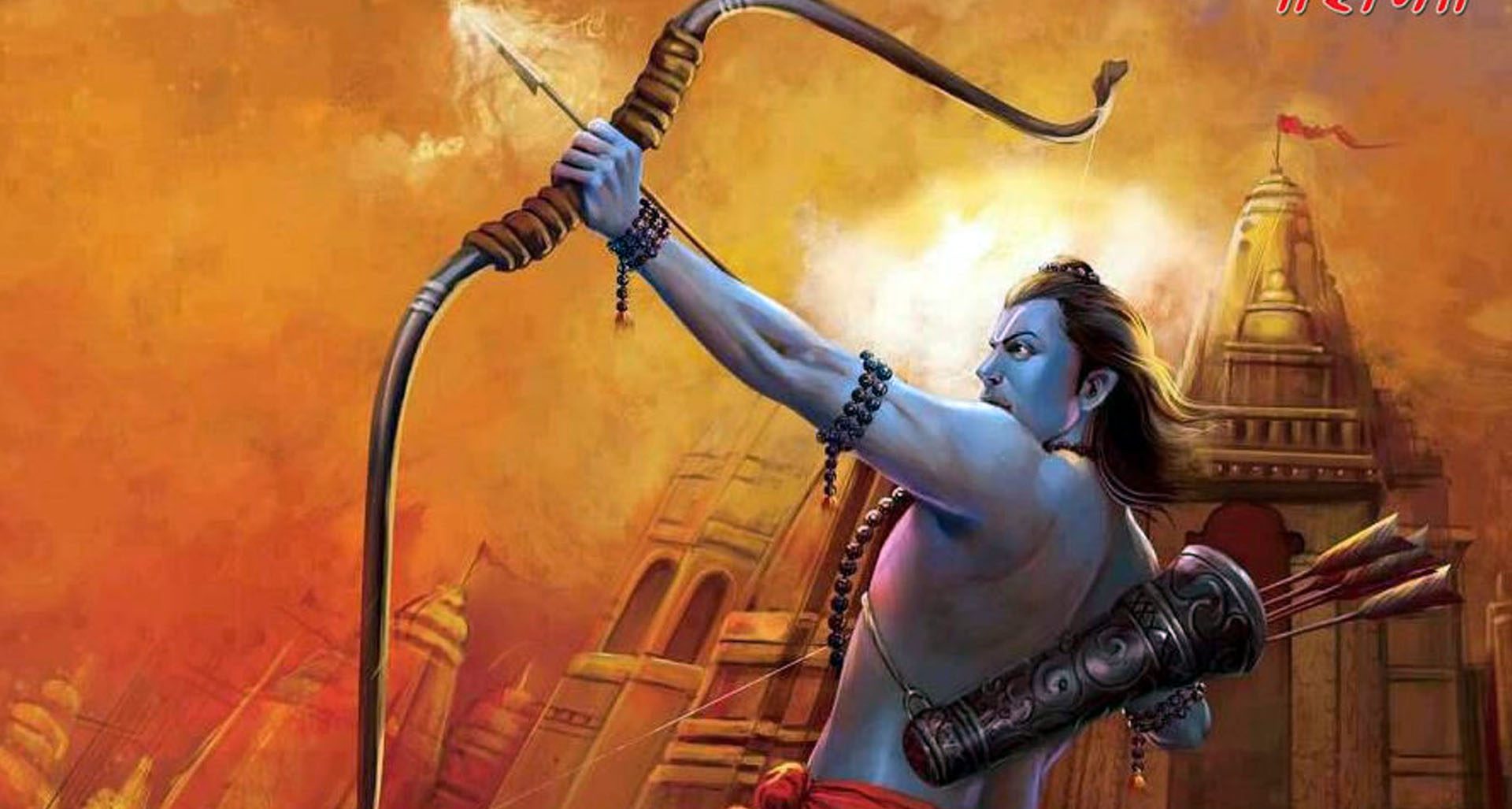
According to Bichitra Natak, said to be the autobiography of the last Sikh Guru, Gobind Singh, the Bedi sub-caste of the Khatris derives its lineage from Kush, the son of Rama (according to Hindu epic Ramayana). The descendants of Kush, according to the disputed Bachitar Natak legend, learned the Vedas at Benares and were thus called Bedis (Vedis).
Similarly, according to the same legend, the Sodhi sub-caste claims descent from Lav, the other son of Lord Rama.
According to Ancient Greek sources, “The people that held the territory comprised between the Hydrastes (Ravi) and the Hyphasis (Beas) were the Khatriaioi, whose capital was Sangala”. Sangala finds mention in Mahabharata and Pali Buddhist texts as the capital of the Madra Kingdom. J. W. McCrindle, the translator, and writer add that the name is found in the modern era, spread across a vast region in the northwest of India, from Hindukush to Bengal and from Nepal to Gujarat, in slightly variant forms, including the term Khatris and others.
Having gained the patronage of the Mughal nobles, the Khatris then adopted administrative and military roles outside the Punjab region. According to a Khatri legend of the 19th century, they continued their military service until the time of the Mughal emperor Aurangzeb, when the death of many of their number during the emperor’s Deccan Campaign caused him to order their widows to be remarried.
The order was made out of sympathy for the widows but when the Khatri community leaders refused to obey it, Aurangzeb terminated their military service and said that they should be shopkeepers and brokers. This legend is probably fanciful: John McLane notes that a more likely explanation for their revised position was that a Sikh rebellion against the Mughals in the early 1700s severely compromised the Khatri’s ability to trade and forced them to take sides. Those who were primarily dependent on the Mughals went to significant lengths to assert that allegiance in the face of accusations that they were in fact favoring the rebel Jat Sikhs, led by Banda. The outcome of their assertions – which included providing financial support to the Mughals and shaving their beards – was that the Khatris became still more important to the Mughal rulers as administrators at various levels, in particular, because of their skills in financial management and their historic connections with bankers.[18]
The Khatris played an important role in India’s trans-regional trade during the period, being described by Scott Cameron Levi as among the “most important merchant communities of early modern India.”
Dale locates Khatris in Astrakhan, Russia during the late seventeenth century and, in the 1830s, the British imperial proconsul and past governor of Bombay, Mountstuart Elphinstone, was informed that Khatris were still highly involved in northwest India’s transregional commerce and that they maintained communities throughout Afghanistan and as far away as Astrakhan.[21] Often, they married Tatar local women, and the children from these marriages were known as Agrijan.
According to George Campbell’s mid-nineteenth-century Ethnology of India, “Khatris are the only Hindus known in Central Asia”
Author Suresh Kumar described Khatris as silk weavers. Author Purnima Dhawan described that together with Jat community, the Khatris gained considerably from the expansion of the Mughal empire, although both groups supported Guru Hargobind in his campaign for Sikh self-government in the Punjab plains.[24]
Origin and ritual status
According to Hardip Singh Syan, the Khatris considered themselves to be of pure Vedic descent and thus superior to the Rajputs who, like them, claim the Kshatriya status of the Hindu varna system.[25] As per historian Baij Nath Puri, the Khatris as an integral part of the old Kshatriya caste differ from the neo-Kshatriyas, Rajputras or Rajputs.[26][27] According to Scott C. Levi Despite their participation in occupations similar to those of the Bania communities, Khatris were considered to be Kshatriyas, the second-highest varna in the Indian social hierarchy, below only the Brahmans.[21]
However, these claims are disputed by most of the scholars who consider castes in north India, like Khatri and Kayastha to be merchant castes who claim higher status to befit the educational and economic progress they made in the past.[10] According to Anand Yang, the Khatris are one of the sub-categories of the Bania caste of north India along with numerous groups that are together categorized as Vaishya in the Varna system.[28]
Khatri’s standards of literacy and caste status were such during the early years of Sikhism that, according to W. H. McLeod, they dominated it.[25] Author McLeod mentions the employment of Khatris as soldiers by Mughal emperors but notes by the time of British arrival in India they were mostly merchants and scribes[29] Kenneth W. Jones says “the Khatris claimed with some justice and increasing insistence, the status of Rajputs, or Kshatriyas, a claim not granted by those above but illustrative of their ambiguous position on the great varna scale of class divisions”.[30]
The word Khatri in the Hindi Language comes from the Sanskrit Kshatriya according to the Śabdasāgara Lexicon by Shyamasundara Dasa[31] According to Dr. H.H Wilson, Professor of Sanskrit in the University of Oxford, the word Khatri is the Hindi word for the Sanskrit Kshatriya, the name of the 2nd pure tribe of the caste system.[32] Purnima Dhavan sees the claim as originating from a conflation of the words Khatri and Kshatriya, which are phonetically similar.[33] In the 19th-century British administrators failed to agree whether the Khatri claim of Kshatriya status should be accepted since the overwhelming majority of them were engaged in Vaishya (mercantile) occupation rather than in Kshatriya (military) pursuits.[34] Dasharatha Sharma described Khatris of Rajasthan as a mixed pratiloma caste of low ritual status but suggested that they could be a mixed caste born of Kshatriya fathers and Brahmin mothers.
Historian Vijaya Gupchup from the University of Mumbai states that in Maharashtra, Brahmins showed resentment in the attempt by the Marathi Khatris(Koshti) to elevate themselves from ritually low status to Kshatriya by taking advantage of the British neutrality towards castes. She quotes a translation from a Marathi publication that gave a Brahminic opinion of this attempt:
“Everyone does what he wants, Sonars have become Brahmins, Treemungalacharya was insulted by throwing cow dung at him in Pune, but he has no shame and still calls himself a Brahmin. Similarly, a Khatri or Koshti(weavers) who are included in Panchal at places other than Bombay, call themselves Kshatriya in Bombay and say their needles are the arrows and their thimbles are the sheaths. How surprising that those sonars and Khatris at the hands of whom even Shudras will not take water have become Brahmins and Kshatriyas. In short day by day higher castes are disappearing and lower castes are prospering.”
The Khatris of Gujarat and Rajasthan are said to have tailoring skills like the “Darji” (tailor) caste. In the case of those Khatris who avow Sikhism, their Kshatriya claim reflects the confusing, even seemingly contradictory, attitude towards the traditional Hindu caste system that is evident in Sikh texts such as the Guru Granth Sahib, which on the one hand renounces the Hindu caste paradigm and on the other seeks to portray the gurus as a group of warrior-defenders of their faith, just as with the Kshatriya varna.
Source : Wikipidea
Khatri is a community of north India that originated from Punjab. The region is connected with the composition of Vedas, Mahabharata, and many more.
The word Khatri is a Punjabi word that has been derived from the Sanskrit word “Kshatriya” because of a different accent. They are the warriors and the rulers that belong to ancient India.
Today, they distinguish themselves as Punjabi Khatri due to the emergence of several communities with the name as Khatrey/Kshtri/etc.
Khatri (Punjabi Khatri) is a community consisting of only Suryavanshis (Sun Dynasty) and Chandravanshi (Lunar Dynasty). Only the Punjabi Khatris claim themselves and traced to be the direct or indirect descendants of King Ramachandra and King Krishanchandra, who are believed as the incarnation of Lord Vishnu. Whereas, Rajputs though belong to Sun, Lunar, Fire Dynasties but never say or claim they to be the descendants of King Raam and King Krishan.
Punjabi Khatris consider themselves at the topmost ranking of Varna, which is Brahman, Vaishya, Shudra, etc. Even the Gurus of Khatri is not Brahman as they consider Brahman lower to them and give donations to them.
Hierarchy among Khatris
Among Punjabis, there are several distinct communities, among all the communities the Khatris reside at the top.
In ancient times, the name Khatri was not in existence, rather they were known as the Kshatriya, during the reign of Maurya Dynasty they concentrated in the Potwar Plateau of Punjab.
All most the Khatri belongs to King Padam Anand and King Purush (Porus). There are four subcategories:-
- 1. Khukhrain Khatri
- 2. Dhaih-ye Khatri
- 3. Baharaan Khatri
- 4. Bahu-jayee Khatri
All the above four words were derived from Sanskrit and later spelled in Punjabi.
Earlier only Khukhrains and Dhaih-ye Khatris were present and were known as Anands(Suryavanshi) and Purus(Chandravanshis), later two more subcategories were derived.
Khukhrain Khatri :- In Sanskrit spelt as Kushrayan, means Descendants of King Kush. Progeny of King Padam Anand. It consisted of eight clans Anand, Kohli, Suri, Bhasin, Chaddha, Sawhney, Sethi and Sabharwal. Later three more clans were derived from above Chandhok, Ghai and Ghandhok. They are Suryavanshi and direct descendants of King Raam of Ayodhaya.
Dhaih-ye Khatri :- Many of us misinterpret this word as Dhai (two and half), but its completely wrong. When a building or any object collapses then we say “dhaih gayi”. The name was given to the progeny of King Purush (Porus) in front of whom not one can stand.
It consists of clans Malhotra, Khanna, Kapoor, Mehra and Mehta.
They are Chandravanshi and direct descendants of King Krishan.
Baharaan Khatri :- Again we spell it wrong as baran (Twelve), it has been derived from the sanskrit and hindi words only. They are the Suryavanshi but does not consist descendants of Khukhrain.
This category consist of several clans Tondon, Chopra, Bedi, Wahi, Sodhi, Sondhi, and Gujral.
Bahu- Jayee Khatri :- They are born in many castes, in different words this is the group of different sub-castes of Khatris (that is, Khukhrains, Dhaihye and Baharaan), who on the account of their indiscipline at any time, were out caste from their original higher castes.
In Sanskrit, Bahujayee means “many birth” as , Bahu means Many and Jayee means Birth. They consist both the Suryavanshi and Chandravanshi.
This category consists of many clans/castes.
Other than these, Khatri consist of Naagvanshi.
Naagvanshi clans are Nayyar, Nair and Naik. Khatri considers themselves are Kshatriya but they consider themselves separate from the Khatri community. These clans are also present in the southern part of India and adapted to different cultures there (This will be explained in later topics).
Moreover, the Arora community is separate from Khatris, but they always forcefully say that they are Khatri (This will also be explained in later topics).
The khatris are a trading and mercantile community, who originated in Punjab and spread to the many states in which they now live. Numbering around 2.5 million, they live in Punjab, Delhi, Haryana, Uttar Pradesh, Gujarat, Jammu & Kashmir, Maharashtra, Himachal Pradesh, Bihar, Tamil Nadu, Rajasthan, Madhya Pradesh, and Chandigarh. In all, they are distributed in over 132 districts in the country and have 241 segments.
The Khatri claim to be Rajput: the second highest class of warriors in the fourfold Hindu caste system. They believe that their name is a corrupt derivation of the Sanskrit word Kshatriya, which is a synonym of Rajput. During the British rule of the 19th century, the Khatri virtually had a monopoly over trade in Punjab and neighboring Afghanistan. There is no doubt that the Khatri is an influential community of northwestern India; one that has emerged as one of the most progressive and dynamic in recent years. Before India’s independence and resultant partition in 1947, the Khatri were settled mainly in the western part of pre-partition Punjab (now in Pakistan) and shortly after began migrating to India.
Khatri’s Origin: There are many legendary theories regarding their origin. One legend relates that Parashurama (Rama, 6th incarnation of Vishnu) wanted to massacre the Kshatriyas and caused every Kshatriya woman to miscarry. However, some women escaped and took shelter in Brahmin (highest priestly caste) houses. The Brahmin declared them to be Brahmin and even ate with them in order to show Parashurama that the Kshatriya women were from their caste, and thus saved them. According to this story, the children born of these women became the Khatri.
Languages: The language spoken by the Khatri people varies from state to state. In Punjab, Haryana, and Jammu and Kashmir, the Indo-Aryan language, Punjabi, is their first language and the Gurumukhi script is used to write it. However, in the state of Jammu and Kashmir, they also speak Dogri and Bhadrawahi. Hindi is the primary language in Delhi and Uttar Pradesh and it is written in the Devanagari script. They speak Maithili in Bihar, Mewari or Marwari in Rajasthan, Pahari in Himachal Pradesh, and Kacchi in Gujarat. Most Khatri is also fluent in the Hindi language and many educated Khatri speaks English.
Economy: The Khatris over time evolve are businessmen, traders, professional moneylenders, and financiers. Their business pursuits range from owning and operating village shops to being major wholesale traders and industrialists. However, there are also some who practice agriculture and rear animals. Many are contractors and transporters, while a few are employed in government and private sectors. The Khatri of Gujarat is known for their cloth which they print and dye as well as the specialized art of bandhani (tying and dyeing fabrics), while in Maharashtra they are the traditional weavers of silk saris, especially the famous paithani saris.
The Khatri are also engineers, doctors, scientists, army, police, administrators, politicians, and creative artists. Generally, they are highly literate. They encourage both sons and daughters to study and graduate.
There are many distinguished Khatri Personalities in the Indian Film industry who have been one of the prime contributors in Indian Cinema since pre-partition times. Some of the khatris are also serving the nation by holding the Highly Acclaimed Government Posts like Prime Minister – Ex-Prime Minister Manmohan Singh (Kohli), Ambassadors like Deepak Vohra, Pavan Kapoor (Indian Ambassador- Abudhabi, UAE ), Joint Secretaries, Governers like Ajudhiya Nath Khosla (Orrisa) who have been awarded Padma Vibhushan and Padma Bhushan.
The list of Khatris who have contributed to India’s Development is endless and this list will keep growing as the core values of Khatris have been to Serve as our ancestors since the Vedic ages.
We as Khatris always pledge to “मनुष्य का सबसे बड़ा कर्म दूसरों की भलाई,और सहयोग होना चाहिए।”.


